Rabindranath Tagore

The first non-European Nobel laureate, whose art defied every boundary — poetry, fiction, drama, music, painting, and philosophy.

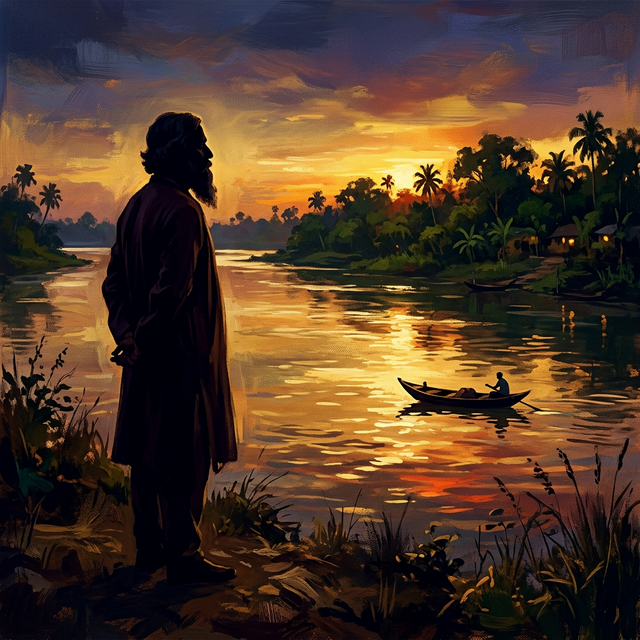
Rabindranath Tagore portrait

A Life of Creative Fire

Rabindranath Tagore (1861–1941) was born in Calcutta into the illustrious Tagore family, a dynasty that shaped Bengali cultural life for generations. The youngest of thirteen surviving children, he grew up in an atmosphere saturated with art, music, literature, and social reform.

Tagore began writing poetry at the age of eight and published his first collection at sixteen. But it was his short stories — written primarily between 1891 and 1895 during his years managing the family estates in rural Bengal — that established his mastery of prose fiction. These stories drew from the lives of tenant farmers, their wives, their children, and the complex social dynamics of colonial Bengal.

In 1913, Tagore became the first non-European to win the Nobel Prize in Literature for Gitanjali, his collection of spiritual poems. He used the prize money to fund his experimental school at Santiniketan, which later became Visva-Bharati University.

Beyond literature, Tagore composed over 2,000 songs (including the national anthems of both India and Bangladesh), pioneered modern Bengali art, established one of Asia's first international universities, and engaged in lifelong dialogues with figures like Einstein, W.B. Yeats, and Gandhi.

He remains one of the most creative and versatile intellects the modern world has produced.

Life & Legacy Timeline

1861

Birth in Calcutta

Born on May 7 in the Jorasanko Thakurbari mansion to Debendranath and Sarada Devi Tagore.

1877

First Publications

Publishes his first substantial poems and a short story at age sixteen, marking the start of his literary career.

1883

Marriage

Marries Mrinalini Devi. The couple would have five children together.

1891–1895

The Golden Period of Short Stories

While managing family estates in Shilaidaha and Shahjadpur, Tagore writes the majority of his greatest short stories — the works explored on this website.

1901

Founding of Santiniketan

Establishes an experimental school at Santiniketan that would grow into Visva-Bharati University — a center of arts and international learning.

1910

Gitanjali Composed

Writes and self-translates Gitanjali (Song Offerings) into English, the work that would bring him world fame.

1913

Nobel Prize in Literature

Becomes the first non-European to win the Nobel Prize, bringing global attention to Indian literature and philosophy.

1915

Knighthood Conferred

Receives a knighthood from King George V, which he would later renounce in 1919 after the Jallianwala Bagh massacre.

1919

Renouncing the Knighthood

In protest of the Amritsar massacre, Tagore returns his knighthood — one of the most powerful acts of political dissent of its era.

1941

Death in Calcutta

Dies on August 7 at the age of eighty, leaving behind an unparalleled body of work spanning poetry, fiction, drama, essays, songs, and paintings.